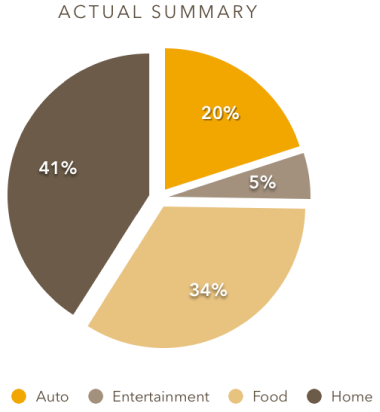
You can change the appearance of a chart by applying a different style to it, changing its font, adding a border, and more.
The thumbnail images at the top of the Chart sidebar represent predesigned chart styles that are specifically made to look good with the template you’re using. You can apply a different style to a chart at any time.
Select the chart.
Click the Chart tab at the top of the sidebar on the right.
If you don’t see a sidebar, or it doesn’t have a Chart tab, click
in the toolbar.
Click one of the chart styles at the top of the sidebar.
If you can’t edit a chart, it may be locked. Unlock it to make changes.
You can change the text of the chart title and value labels so they look different from the other text in a chart.
Select the chart.
Click the Chart tab at the top of the sidebar on the right.
If you don’t see a sidebar, or it doesn’t have a Chart tab, click
in the toolbar.
Do any of the following:
Change the font: Click the Chart Font pop-up menu and choose a font.
Change the character style: Click the pop-up menu below the font name and choose an option.
Make the text smaller or larger: Click the small A or the large A.
All text in the chart increases or decreases proportionally (by the same percentage).
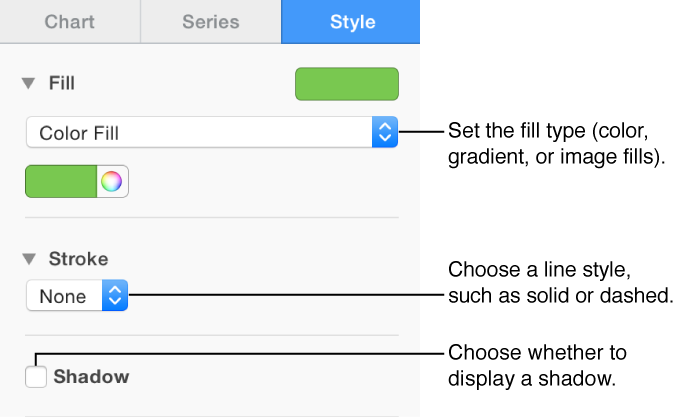
You can change the appearance of individual data series in a chart. Depending on the chart type, you can change the fill type and color, outline (stroke) style, and more. For scatter charts, you can change the symbol that represents each point and add connection lines.
Select the chart, then click one element of a data series (for example, one bar or column, pie wedge, or scatter point).
The entire data series is selected.
Click the Style tab at the top of the sidebar on the right.
If you don’t see a sidebar, or it doesn’t have a Style tab, click
in the toolbar.
Use the controls to make changes.
To see all options, you may need to click the disclosure triangle next to the name of each section.

To change the colors of the data series, click the chart colors button. Hover over a color combination to preview what it looks like.
The changes affect only the selected data series. To modify the appearance of other series, select an element from a different series, then make changes.
For a bar or column chart, you can set the amount of space between the columns or bars.
Select the chart.
Click the Chart tab at the top of the sidebar on the right.
If you don’t see a sidebar, or it doesn’t have a Chart tab, click
in the toolbar.
Click the disclosure triangle next to Gaps, then set the desired amount of space.
Select the pie chart.
Click the Wedges tab at the top of the sidebar on the right.
If you don’t see a sidebar, or it doesn’t have a Wedges tab, click
in the toolbar.
Click the disclosure triangle next to Position, then drag the Distance from Center slider to separate the wedges.

To move a single pie wedge, double-click the wedge, then drag it. To move multiple wedges at the same time, Command-click to select them, then drag.
You can also move the Rotation Angle control to change the orientation of pie wedges. You may want to make a point, for example, by positioning certain wedges at the top or bottom of the chart.
You can add a border to any 2D bar, column, area, or scatter chart.
Select the chart.
Click the Chart tab at the top of the sidebar on the right.
If you don’t see a sidebar, or it doesn’t have a Chart tab, click
in the toolbar.
In the Chart Options section, select the Border checkbox.
To change the border’s appearance, click the disclosure triangle next to Background & Border Style, then use the controls to make changes.
You can change the chart depth, lighting style, bevels, and rotation of 3D charts.
Select the chart.
Click the Chart tab at the top of the sidebar on the right.
If you don’t see a sidebar, or it doesn’t have a Chart tab, click
in the toolbar.
Click the disclosure triangle next to 3D Scene.
Use the controls in the 3D Scene section to make adjustments to the chart.
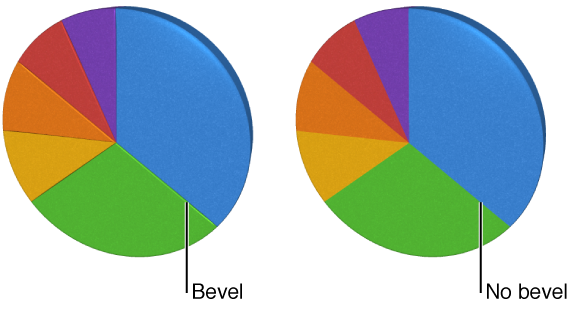
You can increase the distinction between series in 3D stacked bar or column charts and 3D pie charts by beveling the edges where the series meet.

Select the chart.
Click the Chart tab at the top of the sidebar on the right.
If you don’t see a sidebar, or it doesn’t have a Chart tab, click
in the toolbar.
Click the disclosure triangle next to 3D Scene.
Select the Show Bevels checkbox.