You can use keyboards and other input devices to enter text in other languages. To use another language in your document, you must first set up an input source (a language-specific keyboard or character palette, for example) for the language.
Pages also supports bidirectional text, so you can enter and edit text written from left to right (such as in English or Chinese) and from right to left (such as in Arabic or Hebrew) in the same document. You can use bidirectional text in paragraphs, shapes, and tables.
Note: You can use any Pages template to create a bidirectional document, but to see templates designed specifically for another language, you must set the primary language of your computer to that language (in Settings, tap General, tap Language & Region, then set the language). When you create a new document, you see templates for that language.
To use another language in your document, first set up an input source (a language-specific keyboard or character palette, for example) for the language.
On the Home screen, tap Settings, then tap General.
Tap Keyboard, tap Add New Keyboard, then tap the keyboard you want to enable.
To learn about using different languages and keyboards, see the user guide for your device.
If Pages is open, quit Pages and reopen it so that it recognizes the source.
To switch to another input source, tap  at the bottom of the keyboard.
If you switch to a language written in a different direction from the current language, the insertion point moves to the side of the document used by the new language. For example, if you switch the input source from English to Hebrew, the insertion point moves to the right side of the document.
You can create a document that displays page numbers, and dates, time, and currency in tables and charts, using the formatting conventions of a specific language and region. You might want to do this if your document is to be used by people in a different country.
A document’s language and region determine whether commas or periods are used as decimal points in numbers, which currency symbol is used, how dates are formatted, and so on.
To create a document that uses the formatting of a different language, you must have more than one input source (for example a second keyboard) added in Settings. For more information, see Set up a keyboard or other input source for another language.
Note: This setting affects only the document you’re creating.
In the document manager, tap Create Document, or tap  at the top of the screen.
Tap the language in the top-right corner of the template chooser, then choose another language.
Tap the template you want to use.
When you choose a new language, the template titles and text and some of the formatting controls change to reflect that language.
When you view a document that uses a different language from your device’s, a message near the bottom of the document indicates which formatting is used. To see examples of the formatting differences, tap the language in the message.
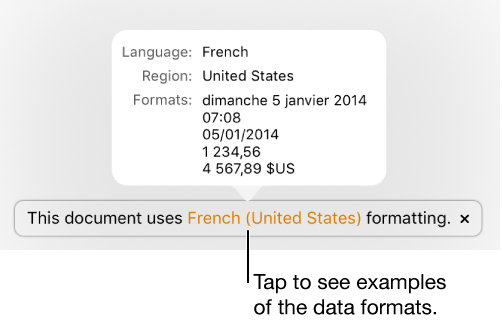
After you create a document, you can change its language setting while the document is open. This setting determines how page numbers and numeric values in tables and charts are displayed—for example, whether commas or periods are used as decimal points in numbers, which currency symbol is used, how dates are formatted, and so on. It affects only the document you change it for.
To change a document's language and numerical formatting, you must have more than one input source (for example a second keyboard) added in Settings. For more information, see Set up a keyboard or other input source for another language.
Note: You can’t change this setting for a shared document.
Tap  , then tap Language & Region.
You may need to swipe up in the controls to see Language & Region.
Tap Language and choose a new language.
If you choose the first item in the Language pop-up menu (System [language]), you reset the document to the language and region of your device. If you subsequently change your device’s language setting, or if you open the document on a device with a different language setting, the document’s language and region automatically change to match the device’s. But if you share the document, all users see the document in your language and region.
Tap Region (if it’s active) and choose a region.
Tap Done.
After you change the document’s language and region, any new table and chart data you enter reflects the new language. For existing table and chart data, the language in dates (for example, month names) changes, but the punctuation in dates and the order of the day, month, and year don’t change. The punctuation in numbers (for example, the decimal point and thousands separator) does change.
The ruler and its tab stops always match the direction of a paragraph, so when you change the direction for selected text, the ruler also changes.
Tap in a paragraph or list, or select text.
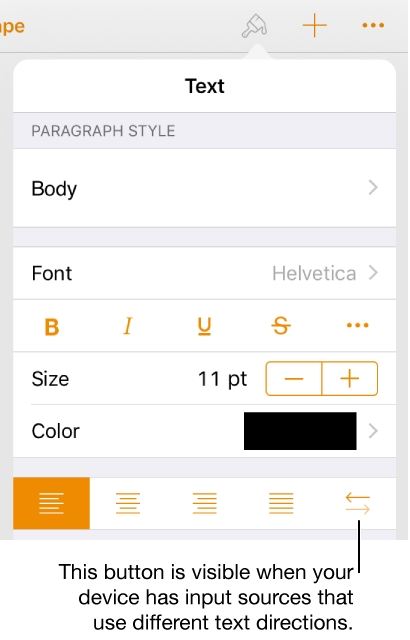
Tap  , tap Text (or Cell if the text is in a table), then tap
  .
.
The insertion point moves to the other side, and the text direction changes.
Enter text, then tap Return at the end of the paragraph.
The next paragraph continues in the same direction. To change its direction, tap , or change the language in the keyboard.
If you select multiple paragraphs with different text directions and then tap , the paragraphs are formatted to match the first paragraph in the selection.