
You can add photos and graphics to any sheet from a photo library, or drag photos and graphics from a website or from the Finder. You can crop an image by masking out parts you don’t want, and make adjustments to its background and exposure.
Do any of the following:
Drag an image from your computer or a webpage to a media placeholder or anywhere else on the sheet.
Click  in the bottom-right corner of a media placeholder, then select an image from a photo library.
Click  in the toolbar, then drag an image from a photo library to the sheet or to a media placeholder.
To search for an image, click the magnifying glass in the upper-right corner of the media window.
Choose Insert > Choose (from the Insert menu at the top of your screen), select an image, click Insert, then drag the image to where you want it.
Note: To ensure that large images look clear on iOS devices even after scaling, choose File > Advanced > Optimize Movies and Images for iOS (from the File menu at the top of your screen).
When you replace an media placeholder with your own image, the new image is no longer a placeholder. If you try to add a different image over the one you added, the images overlap. To use a different image from the one you added, press Command-Z to remove the image and restore the placeholder, then add the new image.
If you can’t replace an image on a sheet, the image may be locked or grouped.
You can add a media placeholder (to which you can add an image, video, or audio file) to a spreadsheet. Using a media placeholder lets you easily replace media without disturbing other elements on the sheet.
Add an image to the sheet, then format it how you want images to appear in the spreadsheet.
You can add a mask, add a border, rotate the image, change its size, and more.
Select the image, then choose Format > Advanced > Define as Media Placeholder (from the Format menu at the top of your screen).
You can hide unwanted portions of an image without modifying the image file.
Double-click the image.
The mask controls appear. The default mask is the same size as your image.
Tip: To display the mask controls on a Mac with a Force Touch trackpad, force click the image (press firmly on the trackpad until you feel a deeper click).
Use the controls to frame just the parts of the image you want to be visible.
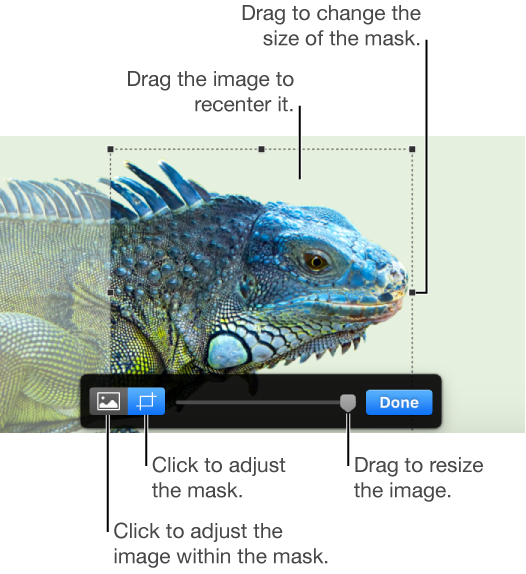
Click Done.
Use the Instant Alpha tool to make parts of an image transparent. This feature is useful for removing an unwanted background or color from an image.
Select the image, then click the Image tab at the top of the sidebar on the right.
If you don’t see a sidebar, or the sidebar doesn’t have an Image tab, click  in the toolbar.
Click Instant Alpha.
On the image, click the color you want to remove, then drag slowly over it.
As you drag, the selection grows to include areas that use similar colors. Click and drag multiple times to remove multiple colors.
Remove all instances of the color (even in other parts of the photo): Hold down the Option key while you drag.
Add colors back to the image: Hold down the Shift key while you drag.
Click Done, or click Reset to undo all your changes and restore the image to its original state.
Select the image, then click the Image tab at the top of the sidebar on the right.
If you don’t see a sidebar, or the sidebar doesn’t have an Image tab, click in the toolbar.
Use the controls to make adjustments:
Exposure: Changes the overall lightness or darkness of the image.
Saturation: Changes the richness of color in the image. Dragging to the right makes the colors richer or more vibrant.
Enhance: Automatically adjusts the image by spreading the red, green, and blue tones evenly across the histogram.
To see the image histogram and adjust more advanced features like contrast, highlights, shadows, sharpness, de-noise, temperature, and tint, click  .
.
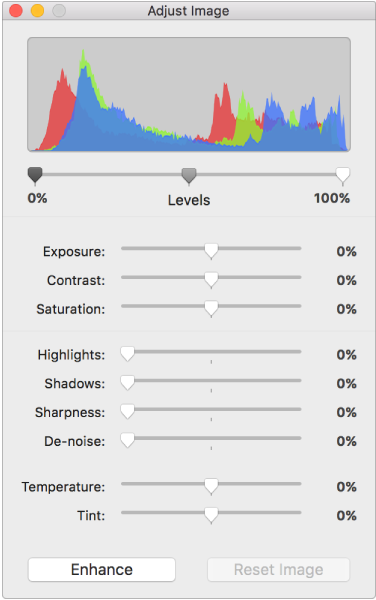
To restore the original settings, click Reset, or click Reset Image in the Adjust Image window.
You can open the Adjust Image controls in a separate window that you can move anywhere. Choose View > Show Adjust Image (from the View menu at the top of your screen).
Tip: You can also add these buttons to the toolbar: Adjust Image, Instant Alpha, and Mask.