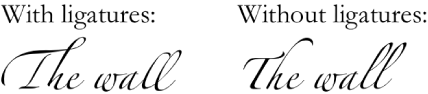

Some fonts include ligatures, a decorative joining of two characters to form a single typographic character. You can use ligatures in your document if the font you’re using supports them.
You can turn on ligatures for the whole document, then turn them off for selected text, or turn off ligatures for the document then turn them on for selected text.
In addition to adding ligatures, you can make other adjustments to the spacing between characters, and change the spacing of text in relation to other text.
Click  in the toolbar.
Click the Document tab at the top of the sidebar.
Select the Ligatures checkbox (or deselect it if you don’t want to use ligatures).
Select the text you want to change.
Click the Style button near the top of the sidebar on the right.
If you don’t see a sidebar, or it doesn’t have a Style button, click  in the toolbar. If the text is in a text box, table, or shape, first click the Text tab at the top of the sidebar, then click the Style button.
In the Font section, click  , then choose an option from the Ligatures pop-up menu.
Use Default: Uses a subset of ligatures for the font.
Use None: Uses regular spacing with no ligatures for the font.
Use All: Uses all available ligatures for the font.
To remove ligatures from selected text, click the More button in the sidebar, then select the “Remove ligatures” checkbox.
Select the text you want to change.
Click the Style button near the top of the sidebar on the right.
If you don’t see a sidebar, or it doesn’t have a Style button, click in the toolbar. If the text is in a text box, table, or shape, first click the Text tab at the top of the sidebar, then click the Style button.
In the Font section, click , then use the arrows to change the Character Spacing value.
The default spacing is zero. Increasing the value widens the spacing, and decreasing the value tightens it.
If you selected text: Your setting affects only the selected text, so any new text you enter won’t be spaced the same way. If you want other text in the document to use the same settings, you can define a new paragraph style from your selection, then use that style for other text in your document.
If you selected a text box: Your setting applies to all of the text in the text box as well as to any text you enter in the text box after you apply the change.
If you have MathType 6.7d or later installed, you can use it to include mathematical expressions and equations in your document.
Click where you want the equation to appear.
Click  in the toolbar, then choose MathType Equation.
Type or paste your equation in the field provided.
See MathType Help for instructions on using the MathType tools.
To save your equation, click the File menu at the top of your screen, choose “Close and Return to Pages,” then click Yes in the window that appears.
The equation appears at the insertion point in your document. To edit the equation, double-click it to open MathType again.