
In a page layout document document, objects are always anchored to the page. In a word-processing document, you must specify what objects are anchored to:
A specific location on the page: The object doesn’t move when you add text or other objects to the page.
Specific text: The object moves with its associated text, and a marker  appears in the text where the object is anchored.
For both types of documents, you can also specify how text wraps around objects.
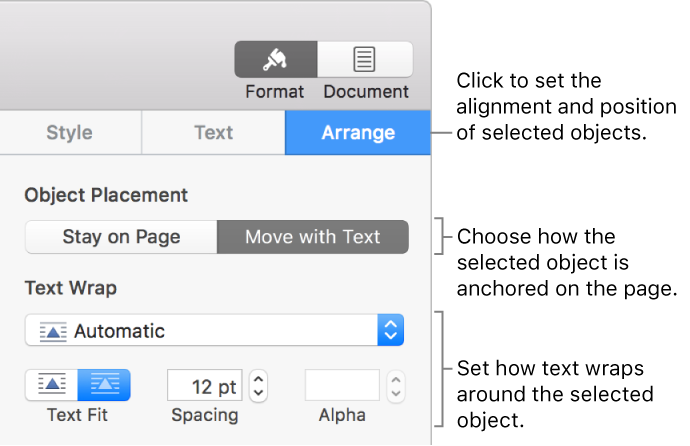
Select the object.
In the Format  sidebar, click the Arrange tab.
Click a button in the Object Placement section:
Stay on Page: The object stays in a fixed location on the page, and text flows around it.
Move with Text: The object maintains its position in relation to the text it’s anchored to.
If Move with Text is dimmed, then the document is a page layout document, which means objects can’t be anchored to text.
If the document is set to show invisibles, or if you select the object, you see a marker in the text where the object is anchored. You can’t drag the marker to another location.
Select the object.
In the Format sidebar, click the Arrange tab.
Click the Text Wrap pop-up menu and choose an option:
Automatic: The object uses whichever text wrap option seems most appropriate for the object’s placement in relation to the page and surrounding text.
Around: Text flows on all sides of the object.
Above and Below: Text flows above and below the object but not on the sides.
Inline with Text: The object sits on the baseline of the text and moves with the text. If you don’t see this option, make sure Move with Text is selected.
None: The object doesn’t affect the flow of text.
If the object isn’t rectangular and you want the text to follow the object’s outline, click the Text Fit button on the right.
To change the amount of space between the text and the object, adjust the value in the Spacing field.
If the object has an alpha channel (transparency), you can make text show through the transparent area by adjusting the value in the Alpha field.