
You can include mathematical expressions and equations in your document. To add an equation, you compose it in the Pages equation dialog using LaTeX commands or MathML elements, then insert it into your document.
You can add equations inline with body text or as non-inline objects. An inline object is embedded in the text flow and moves with the text. A non-inline object is fixed to a particular position on a page. You can drag non-inline objects anywhere on a page, wrap text around them, or layer text or other objects over or behind them.
Note: If you’ve installed MathType 6.7d (or later), an application for composing math expressions, you can use it to create equations by clicking symbols and typing in the MathType window.
Do one of the following:
Add an inline equation: Place the insertion point in the text, or select the text you want the equation to replace. Only word-processing documents can use inline equations.
Add a non-inline equation: Click outside of the document to make sure nothing is selected.
Click  in the toolbar, then choose Equation.
You can also choose Insert > Equation (from the Insert menu at the top of your screen).
If you have MathType installed, a dialog appears asking whether to use Pages to create the equation; click Use Pages.
Enter an equation in the field using LaTeX commands or MathML elements.
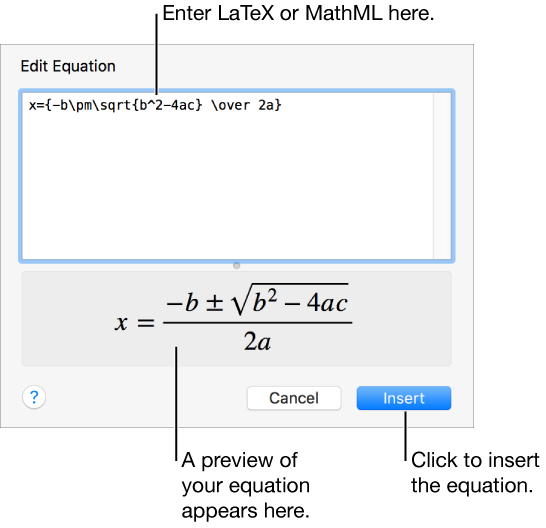
For information on using supported LaTeX commands or MathML elements and attributes, see the Apple Support article About LaTeX and MathML support.
Click Insert.
An inline equation appears at the insertion point in your document and is the same size and color as the surrounding text. If you change the size and color of the surrounding text, the size and color of the equation also change.
A non-inline equation appears at the center of the screen and has a default size and color that you can change in the Format  sidebar. Drag the equation to reposition it on the page.
If you have MathType 6.7d (or later) installed, you can use it to add equations to your document.
Tip: To set MathType as the default equation editor, choose Pages > Preferences (from the Pages menu at the top of your screen), click General, then select the checkbox next to “Insert and edit equations with MathType.”
Do one of the following:
Add an inline equation: Place the insertion point in the text, or select the text you want the equation to replace. Only word-processing documents can use inline equations.
Add a non-inline equation: Click outside of the document to make sure nothing is selected.
Click in the toolbar, then choose Equation.
If you set MathType as your default equation editor, MathType opens automatically (after the first time you enter an equation). Otherwise, click Use MathType in the dialog that appears.
To enter the equation, click symbols and type in the MathType window.
For instructions on using the MathType tools, see MathType Help.
To save your equation, choose File > Close and Return to Pages (from the File menu at the top of your screen), then click Yes in the dialog that appears.
An inline equation appears at the insertion point and is the same size and color as the surrounding text. To edit the equation, double-click the equation to open the MathType window.
A non-inline equation appears at the center of the screen and can be dragged to a new position on the page. To change the look of the equation or to edit it, double-click the equation to open it in MathType, then double-click the controls at the bottom of the window.
Drag the equation to reposition it on the page.
After you add an inline equation, you can modify it.
Edit an equation: Double-click the equation, make your changes, then click Update.
Move an equation: Select the equation and drag it to a new position in the body text, header, or footer.
Change the size, color, or alignment of an equation: Click the equation, then use the controls in the Text tab of the Format sidebar to change the font size, color, or alignment of the equation.
Copy an equation: Click the equation, choose Edit > Copy (from the Edit menu at the top of your screen), place the insertion point where you want to paste the equation—in a table cell or in a page header or footer—then choose Edit > Paste. You can also select an object on the page (such as a shape), then choose Edit > Paste to paste the equation as a non-inline object.
Delete an equation: Click the equation, then press Delete on your keyboard.
Convert an inline equation to a non-inline equation: In a word-processing document, select the equation, then in the Arrange sidebar, click the Text Wrap pop-up menu to choose how text wraps around the equation.
After you add a non-inline equation, you can modify it.
Edit an equation: Double-click the equation, make your changes, then click Update.
Move an equation: Drag the equation to another location on the page.
Change the size, color, or alignment of an equation: Click the equation, then use the controls in the sidebar to change the font size and color. You can also drag a handle on the equation to change its font size.
Copy an equation: Click the equation, choose Edit > Copy, scroll to the page where you want to place the equation, then choose Edit > Paste. You can also place the insertion point in a table cell or in a page header or footer, then choose Edit > Paste to paste the equation as an inline object.
Delete an equation: Click the equation, then press Delete on your keyboard.
Convert a non-inline equation to an inline equation: In a word-processing document, select the equation, then in the Arrange sidebar, click the Move with Text button. Click the Text Wrap pop-up menu, then choose Inline with Text. Drag the equation to its final location.