Use bidirectional text

Pages supports bidirectional text, so you can enter and edit text written from left to right (such as in English or Chinese) and from right to left (such as in Arabic or Hebrew) in the same document. You can use bidirectional text in paragraphs, shapes, and tables.

To use another language in your document, you must first set up an input source (a language-specific keyboard or character palette, for example) for the language.

Note: You can use any Pages template to create a bidirectional document, but to see templates designed specifically for another language, you must first set the primary language of your computer to that language (in System Preferences, click Language & Region, then set the language).

Use another language in Pages

To use another language in your document, first set up an input source (a language-specific keyboard or character palette, for example) for the language.

  1. Open System Preferences on your Mac, click Keyboard, then click Input Sources.

    System Preferences is in the Apple menu at the top-left corner of your screen.

  2. Click the + at the bottom of the left column and choose the keyboard you want to enable, then click Add.

  3. Select the checkbox next to “Show Input menu in menu bar.”

    For more information about input sources, click Help in the menu at the top of your screen, then search for “input sources.”

  4. If Pages is open, restart Pages so that it recognizes the source.

  5. To switch to the other keyboard, click the Input menu on the right side of the menu bar, then choose a keyboard.
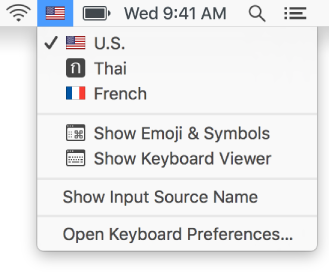
    The Input menu in the upper-right corner of the menu bar

If you switch to a language written in a different direction from the current language, the insertion point moves to the side of the document used by the new language. For example, if you switch the input source from English to Hebrew, the insertion point moves to the right side of the document.

Change paragraph text direction

The ruler and its tab stops always match the direction of a paragraph, so when you change the text direction for selected text, the ruler also changes.

  1. Click in a paragraph or list, or select text in a paragraph or list.

  2. Click the Style button near the top of the sidebar on the right.

    If you don’t see a sidebar, or the sidebar doesn’t have a Style button, click Format button in the toolbar. If the text is in a text box, table, or shape, first click the Text tab at the top of the sidebar, then click the Style button.

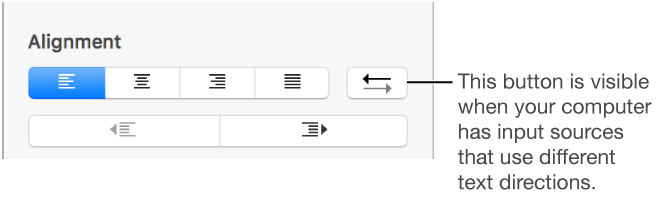
  3. In the Alignment section, click Paragraph direction button.

    The insertion point moves to the other side, and the paragraph direction changes.

    The bidirectional button in the Alignment section of the Format sidebar
  4. Enter text, then press Return at the end of the paragraph.

    The next paragraph continues in the same direction. To change its direction, click Paragraph direction button.

If you select multiple paragraphs with different text directions and then click Paragraph direction button, the paragraphs are formatted to match the first paragraph in the selection.

To learn how to type and edit bidirectional text, and to use some of the supporting features in OS X, click Help at the top of your screen and search for “bidirectional text.”

See also
Format Chinese, Japanese, or Korean text
Format tables for bidirectional text