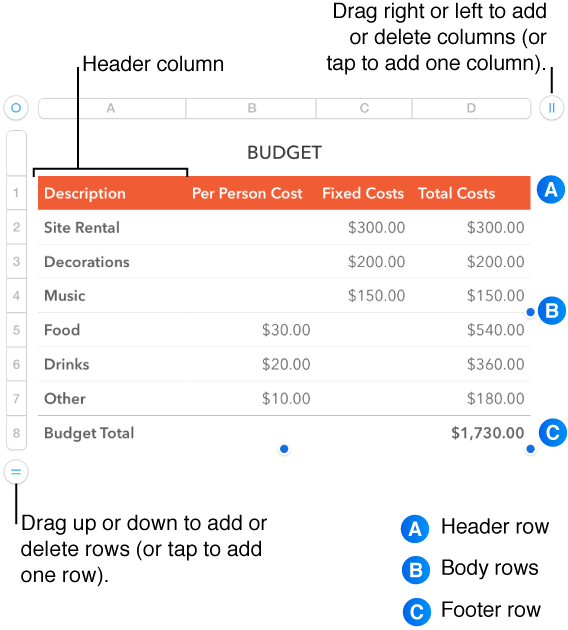
There are three types of rows and columns:
Header rows and columns display labels identifying what each row and column contains. Data in header cells isn’t used in formulas. Headers are optional; you can have up to five header rows and five header columns.
Body rows and columns contain table data. A table must contain at least one body row and one column.
Footer rows appear at the bottom of a table.
For large spreadsheets, you can freeze (or lock) header rows and columns so that they are always visible when you scroll the spreadsheet.
Do one of the following:
Add or delete a row or column at the edge of the table: Tap  at the bottom or
  at the top of the table. (Drag the control to add or delete more than one row or column.) You can delete a row or column only if all of its cells are empty.
Insert or delete a row or column within the table: Tap the table, tap a bar above a column or to the left of a row, then tap Insert or Delete.
Adding header rows, header columns, or footer rows converts existing rows or columns into headers or footers. For example, if you have data in the first row of a table and you add a header row, the first row is converted to a header using the same data.
You can freeze header rows or columns so they’re always visible as you scroll the spreadsheet.
Tap the table, tap  , then tap Headers.
Do any of the following:
Add or delete headers and footers: Tap  or
or  next to a header or footer category.
Freeze header rows or columns: Turn Freeze Rows or Freeze Columns on or off.
Tap the table.
A bar appears above the columns and to the left of the rows.
Do any of the following:
Select a single row or column: Tap the bar for the row or column you want to select.
Select multiple rows or columns: Tap the bar for a row or column, then drag a selection handle (a blue dot) to encompass the rows or columns you want.
Select one or more rows or columns, then do any of the following:
Move rows: Touch and hold the row bar until the row appears to lift off the table, then drag above or below another row.
Move columns: Touch and hold the column bar until the column appears to lift off the table, then drag to the right or left of another column.
You can transpose the rows and columns in a table to switch them—Row 1 becomes Column A (the contents of row 1 move into column A) and vice versa, Row 2 becomes Column B, and so on.
Tap the table.
Tap  in the top-left corner of the table, then tap Transpose.
These are the results of transposing:
Rows and columns resize to the default width and height for the table.
Header rows become header columns and footer rows become the rightmost columns.
The table style presets and manual style changes are preserved, including alternating row colors, grid line settings, table and cell outlines, cell and text style, conditional highlights, hidden rows and columns, and so on.
Chart data references update.
Merged cells transpose normally, unless they’re in the header row. In a few cases, transposing unmerges merged header row cells.
Transposing a table discards the sort and filter rules and unlinks a linked form, if transposing results in a table that’s not a valid form.
Many formulas and functions transpose and update. Warnings indicate formulas that can’t be updated.
Note: To revert all the changes, select the table and transpose it again. This undoes the previous transposing.
You can change the width of specific columns and the height of specific rows in a table.
Tap the table, then select the row or column you want to resize.
Drag  to resize.
To resize all rows or columns in a table, tap the table, tap , then drag a selection handle (a blue dot).
Hiding rows or columns is useful if, for example, you need to use their data for formulas, but you don’t want the data to be visible.
When you sort columns, the hidden cells are also sorted.
Tap the table.
Tap the bar for the row or column you want to hide, then tap Hide.
To show hidden rows or columns, tap a row or column bar adjacent to the hidden ones, then tap Unhide Rows or Unhide Columns.
If you import a Numbers or Microsoft Excel spreadsheet with filtering turned on, some rows in your table may be hidden (or filtered). To display rows that are filtered out, you must turn off filtering.
Tap the table, then tap in the top-left corner.
Tap Turn Filters Off.
To reapply the filtering criteria, tap Turn Filters On. You can’t add or edit filtering criteria on your iOS device.