
Alchemy is an easy-to-use, yet powerful sample manipulation synthesizer. It offers numerous real-time performance controls and an extensive preset library.
Alchemy features additive, spectral, and granular synthesis and resynthesis, sampling, and virtual analog engines. You can analyze imported samples and can manipulate them using one or more of these synthesis methods. Alchemy provides extensive sample mapping, looping, and grouping facilities that make it easy to create instruments containing hundreds of samples and layers. If you want to create purely synthetic sounds, the additive, spectral, and virtual analog synthesis engines are full-featured, matching or exceeding the power and facilities of many standalone instruments.
An Alchemy preset can contain up to four sources, each using one or more synthesis engines. You can morph or crossfade between these sources. Dozens of modeled analog and digital filters are available, in addition to multiple racks of integrated effect units and an extensive modulation section. Alchemy also features a powerful arpeggiator that can control each source independently and provides flexible pattern modulation options.
If you are new to synthesizers and different synthesis methods, see Synthesizer basics overview.
Before you can design new sounds with Alchemy you need to understand how its different parts fit together, and how each of them contributes to what you hear.
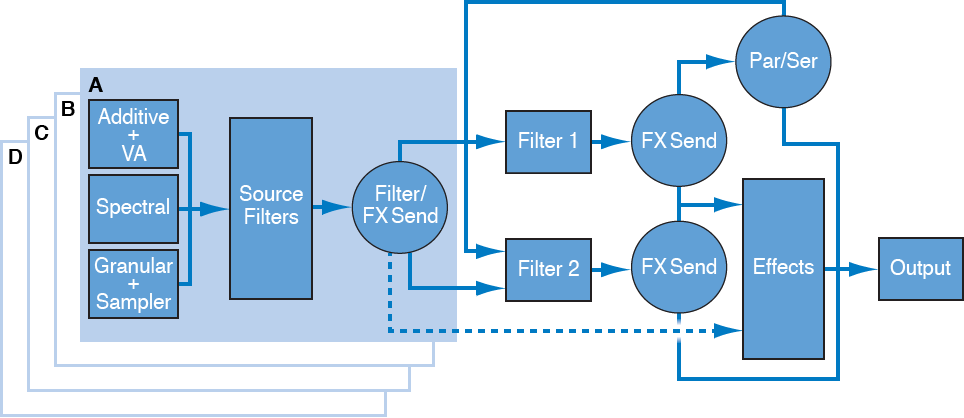
At first glance Alchemy may seem complex, but its layout is relatively simple:
The diagram shows signal flow from left to right through the different sound generating and processing modules.
There are three basic stages:
Each sound can contain up to four sources: A, B, C, and D. Each source consists of additive, spectral, granular, sampler, and virtual analog elements. Multiple elements can be active in each source. Each source has three independent filters that can operate in parallel or in series. These sources are used to create and shape the basic tone of the sound. All modulation in this section applies per-voice.
There are two main filters that can operate in parallel or in series. The main filters are used to shape or otherwise alter the combined sound from the four sources. All modulation in this section applies per-voice.
After the individual voices are mixed together and filtered, they pass through the effects stage. Any modulation of the effects section is applied to the entire audio signal sent from the main filter section. You can also directly route sources (post source filters, if used) to the effects section, bypassing the main filters altogether.