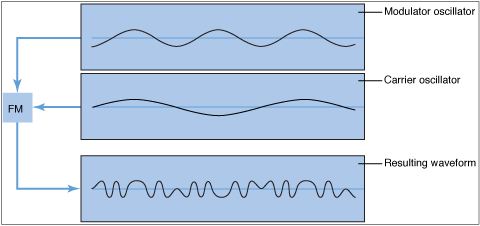

FM synthesis uses a modulator oscillator and a sine wave carrier oscillator. The modulator oscillator modulates the frequency of the carrier oscillator within the audio range, thus producing new harmonics. These harmonics are known as sidebands.
Typically, FM synthesizers don’t incorporate a filter. You can generate some subtractive synthesizer style sounds with FM synthesis, but it is difficult to recreate the sound of a resonant subtractive synthesizer filter using this method. FM synthesis is extremely good, however, at creating sounds that are difficult to achieve with subtractive synthesizers—sounds such as bell timbres, metallic tones, and the tine tones of electric pianos. Another strength of FM synthesis is punchy bass and synthetic brass sounds.
The EFM1 and Retro Synth FM synthesizers can produce many of the classic FM sounds made famous by Yamaha’s DX series of synthesizers. The DX7, sold from 1983 to 1986, remains the most commercially successful professional-level hardware synthesizer ever made.
ES2 also features some FM techniques that allow you to modulate one oscillator with another. You can use these FM techniques to partially bridge the gap between the digital sound of FM synthesis and the fat analog sound that ES2 is noted for.