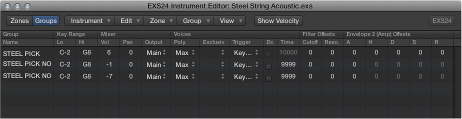

Group parameters provide simultaneous control of all assigned zones.
Group parameters
Group Name field: Displays the group name. Click to enter a name.
Key Range fields: Define a key range for the group.
Lo: Sets the lowest note for the group.
Hi: Sets the highest note for the group. Playing notes outside this range does not trigger the zones assigned to this group.
Note: Take your time with these parameters because as they override zone range settings, possibly making some zones inaudible.
Vol(ume): Adjusts the overall level of the group—and, therefore, the volume of all zones in the group. This works much like a subgroup on a mixing console.
Pan: Adjusts the pan position of the group—stereo balance for stereo samples—and the pan position of all assigned zones simultaneously.
Note: This will affect any individual zone panning adjustments.
Output: Determines the outputs used by the group. Choices include the main outputs and paired channels 3 and 4, 5 and 6, 7 and 8, 9 and 10, or individual outputs 11 through 16. This allows individual groups to be routed independently to aux channels in a multi-output EXS24 mkII instance.
Note: This will have an impact on any individual zone output assignments.
Poly. (polyphony): Determines the number of voices that the group can play. The Max option ensures that the group uses all voices allowed by the Voices parameter in the Parameter window.
A practical use of the Poly parameter is to set up a classic “hi-hat mode” within a full drum kit that is mapped across the keyboard. For example, you could assign an open and closed hi-hat sample to a group, and set the Voices parameter of the group to 1. The most recently triggered of the two hi-hat samples mutes the other because only one voice is allowed for the group. This mirrors the real-world behavior of hi-hats. The other sounds of the drum kit can still be played polyphonically, if samples in zones are assigned to another group.
Trigger menu: Determines if zones pointing to this group are triggered on key down (Key Down setting) or on key release (Key Release setting). This is useful for emulating organ key clicks, for example, where you may want the organ note triggered on key down, but the organ click triggered on key release.
Dc (decay) checkbox: Select the checkbox to access the Decay Time parameter.
(Decay) Time field: Determines the time it takes for the level of a sample (triggered by key release) to decay.
Note: The Decay parameters function only when the Trigger parameter is set to Key Release.
Cutoff and Reso(nance) fields: Independently offset the Cutoff and Resonance settings for each group. This can be useful if you want the initial impact of a note to be unfiltered for one group but not other groups.
Envelope 1/Envelope 2 Offsets fields: Independently offset the envelope settings in the Parameter window for each group. This is useful if you want the filter (Envelope 1) or volume (Envelope 2) envelopes to affect the samples in a group—after the initial impact of the triggered sounds.
H(old) field: Determines the time that the envelope is held at the maximum attack level, before the decay phase begins.
Note: When the Trigger parameter is set to Key Release, the Decay Time parameter controls the decay level, rather than Envelope 2 (the volume envelope). This means that when Trigger is set to Key Release, the Envelope 2 Offsets have no effect.
Vel(ocity) Range: Sets a velocity range for the group. Velocity Range is useful for sounds where you want to dynamically mix—or switch between—samples by playing your MIDI keyboard harder or softer. This feature is ideal for layered sounds, such as a piano/string layer, or when switching between different percussion samples.
Lo: Sets the lowest velocity that triggers the group.
Hi: Sets the highest velocity that triggers the group. Playing notes outside this velocity range will not trigger the zones assigned to this group.
Note: The settings made here override zone settings. When a zone’s velocity range is larger than the group setting, the zone’s velocity range is limited by the group setting.