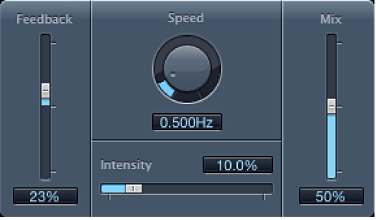

The Flanger effect works in much the same way as the Chorus effect, but it uses a significantly shorter delay time. In addition, the effect signal can be fed back into the input of the delay line.
Flanging is typically used to add a spacey or underwater quality to input signals.
Flanger parameters
Feedback slider and field: Set the amount of the effect signal that is routed back to the input. This can change the tonal color and make the sweeping effect more pronounced. Negative Feedback values invert the phase of the routed signal.
Speed knob and field: Set the frequency, or speed, of the LFO.
Intensity slider and field: Determine the modulation amount.
Mix slider and field: Determine the balance between dry and wet signals.