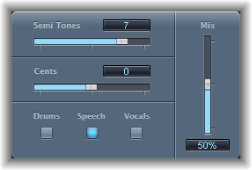

Pitch Shifter provides a simple way to combine a pitch-shifted version of the signal with the original signal. Use pitch shifting to achieve the best results.
Semi Tones slider and field: Set the pitch shift value in semitones.
Cents slider and field: Control detuning of the pitch shift value in cents (1/100th of a semitone).
Drums, Speech, and Vocals buttons: Set one of three optimized algorithms for common types of audio material. Choose from:
Drums: Maintains the groove (rhythmic feel) of the source signal.
Speech: Provides a balance between both the rhythmic and harmonic aspects of the signal. This is suitable for complex signals such as spoken-word recordings, rap music, and other hybrid signals such as rhythm guitar.
Vocals: Retains the intonation of the source, making it well-suited for signals that are inherently harmonic or melodious, such as string pads.
Mix slider and field: Set the balance between the effect and original signals.
Timing pop-up menu (Extended Parameters area): Choose how timing is derived.
Preset: Follows the selected algorithm.
Auto: Analyzes incoming audio.
Manual: Uses the settings of the Delay, Crossfade, and Stereo Link parameters.
Note: The following three parameters are active only when Manual is chosen from the Timing pop-up menu.
Delay slider and field (Extended Parameters area): Set the amount of delay applied to the input signal. The lower the frequencies of the input signal, the higher (longer) a delay time you should set—to effectively pitch shift the signal.
Crossfade slider and field (Extended Parameters area): Set the range (shown as a percentage of the original signal) used to analyze the input signal.
Stereo Link buttons (Extended Parameters area): Click Inv. to invert the stereo channel’s signals, with processing for the right channel occurring on the left, and vice versa. Click Normal to leave the signal as it is.