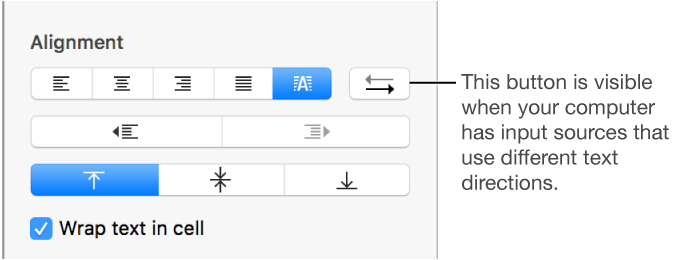
Keynote supports bidirectional text, so you can enter and edit text written from left to right (such as in English or Chinese) and from right to left (such as in Arabic or Hebrew) in the same presentation. You can also reverse the direction of tables to accommodate different languages.
Note: To change the direction of a table or cell text, your computer must be set up for input sources that use different text directions—for example, one keyboard for typing a right-to-left language, such as Hebrew, and another for typing a left-to-right language, such as English. See Set up a keyboard or other input source for another language.
The default direction of text in table cells is based on the current keyboard (selected in the Input menu).
You can change the direction of text in selected cells.
You can change the table direction so that header rows, column order, and other table elements are reversed.
Click the table.
Do one of the following:
Choose Format > Table > Reverse Table Direction (from the Format menu at the top of your screen).
Click the Table tab at the top of the sidebar on the right, then click a Table Direction button at the bottom of the sidebar.
If you don’t see a sidebar, or the sidebar doesn’t have a Table tab, click  in the toolbar.
When you reverse table order, cell alignment is affected as follows:
Text cells set to auto-align (the default setting) change their text alignment.
Number cells set to auto-align (the default setting) don’t change their number alignment. (Numbers always auto-align to be right-aligned.)
If a cell has had its alignment specifically set to right, left, or center, it retains that alignment.
If a cell’s alignment is justified, the gap for a partial line changes from being on the right to being on the left.
 .
.