
You can enter text in many different languages, including several different writing systems for Chinese, Japanese, and Korean, using the international keyboards available on your Mac. Keynote provides some language-specific text-formatting features, including emphasis styles, list styles, and phonetic guides.
For best results, use these recommended fonts:
Simplified Chinese: PingFang SC
Traditional Chinese for Taiwan: PingFang TC
Traditional Chinese for Hong Kong and Macao: PingFang HK
Korean: Apple SD Gothic Neo
Japanese: Hiragino Sans (sans serif) or Hiragino Mincho (serif)
Important: The instructions below assume you enabled at least one Chinese, Japanese, or Korean keyboard on your Mac. To enable international keyboards, open System Preferences, click Keyboard, then click Input Sources.
You can add emphasis marks that are commonly used with Chinese, Japanese, or Korean text. For example, using a Chinese keyboard, you can apply Boten dots below or above the text, or a wavy underline. With Japanese text you can add plain dots or sesame dots.
Switch your keyboard to a Chinese, Japanese, or Korean keyboard.
Select one or more characters of Chinese, Japanese, or Korean text, then click the Text tab at the top of the sidebar on the right.
If you don’t see a sidebar, or the sidebar doesn’t have a Text tab, click  in the toolbar.
Click the Style button near the top of the sidebar, then click an emphasis mark button.
The formatting options depend on which keyboards are enabled.
You can apply Chinese, Japanese, and Korean list styles (specifically, the bullet style or numbering system) to a list written in any language.
Select the list items with the numbering or lettering you want to change.
Click the Text tab at the top of the sidebar on the right, then click the Style button near the top of the sidebar.
If you don’t see a sidebar, or the sidebar doesn’t have a Text tab, click in the toolbar.
Click the disclosure triangle next to Bullets & Lists, then choose Keynote.
Click the pop-up menu above Tiered Numbers, then choose a number or letter sequence.
The formatting options depend on which keyboards are enabled.
If you have a Chinese, Japanese, or Korean keyboard enabled for your Mac or iOS device, you can apply phonetic guides to words written in any language even if you don’t use any of these keyboards.
Select the text.
Don’t include any trailing paragraph breaks or punctuation in your selected text.
Control-click the selected text, then choose Phonetic Guide Text from the shortcut menu.
A phonetic guide appears with the selected text.
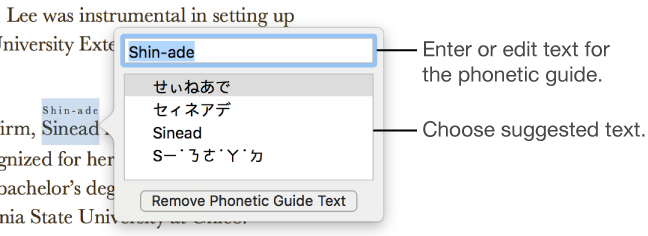
To change the phonetic guide text, choose one of the options in the Phonetic Guide list or type your own in the text field.
Click anywhere outside the Phonetic Guide Text window to apply the text you chose, then close the window.
You can change the language of phonetic guide text or remove the text.
Click the word with phonetic guide text, then choose Phonetic Guide Text from the shortcut menu.
Do one of the following:
Change the guide text: Enter new text, or choose one of the options.
The phonetic options presented depend on which keyboards are enabled.
Remove the guide text: Click Remove Phonetic Guide Text.