
13.7. Album Formatting. The album title must include the composers, followed by a colon, followed by the work titles, catalog numbers, or type of works such as Sonatas or Preludes.
Follow these guidelines for composer name formatting for album titles only:
Last name only. Use this format when there is only one famous composer with a surname that is immediately recognizable. For example, Beethoven, Zemlinsky, or Ligeti.
First name initial(s) and last name. Use this format when multiple famous composers share the same last name. For example, members of the Bach family, including J. S. Bach, C. P. E. Bach, and W. F. Bach.
First name(s) and last name(s). Use this format when multiple famous composers share the same initials and the same last name. For example, Paul Viardot and Pauline Viardot. Felix Mendelssohn and Fanny Mendelssohn.
Examples:
Monteverdi: Vespro della Beata Vergine, SV 206
J. S. Bach: Jesu, meine Freude, BWV 227 – Vivaldi: Gloria in D Major, RV 589
Haydn: Complete Symphonies, Vol. 1
W. A. Mozart: Requiem in D Minor, K. 626
Beethoven: Violin Concerto in D Major, Op. 61 – Brahms: Symphony No. 1, Op. 68
Schubert & R. Schumann: Piano Sonatas
Chopin: Preludes & Nocturnes
Tchaikovsky: The Nutcracker & Swan Lake (Highlights)
Stravinsky: Le sacre du printemps
Britten: Choral Works
If an album is composed and performed entirely by the same artist, the composer does not need to be included in the album title.
Do not use side-by-side translations in metadata. Use only one language in each entry or localization. If an album has an exact release title, such as The Most Beloved Classical Masterworks, that title may be used.
13.8. Key Information. A work must be described in the key it was composed in. Formatting should look like: C-Sharp Major.
13.9. Classical Abbreviations. For accepted abbreviations of catalogs of classical works, see Standard Classical Abbreviations.
13.10. Track Formatting. Track titles must be complete, correctly formatted, and consistent.
If a track features a movement or selection from a larger work like a symphony or concerto, begin the track title with the name of the larger work. This applies even if a track contains a portion of a movement, selection, or excerpt. In this case, “Selection” or “Excerpt” must be stated between parentheses at the end of the work title.
If a work has an assigned catalog number, include the catalog number in the title. Catalog numbers can be found through the International Music Score Library Project.
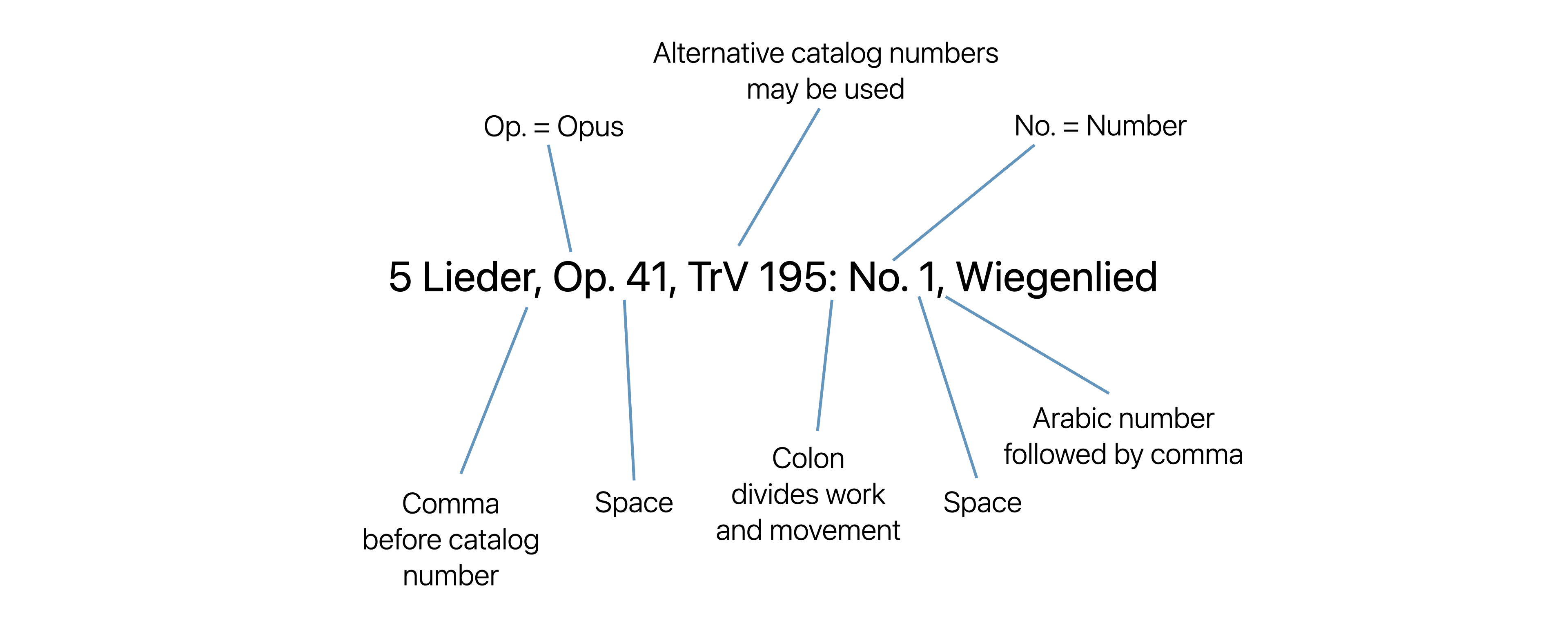
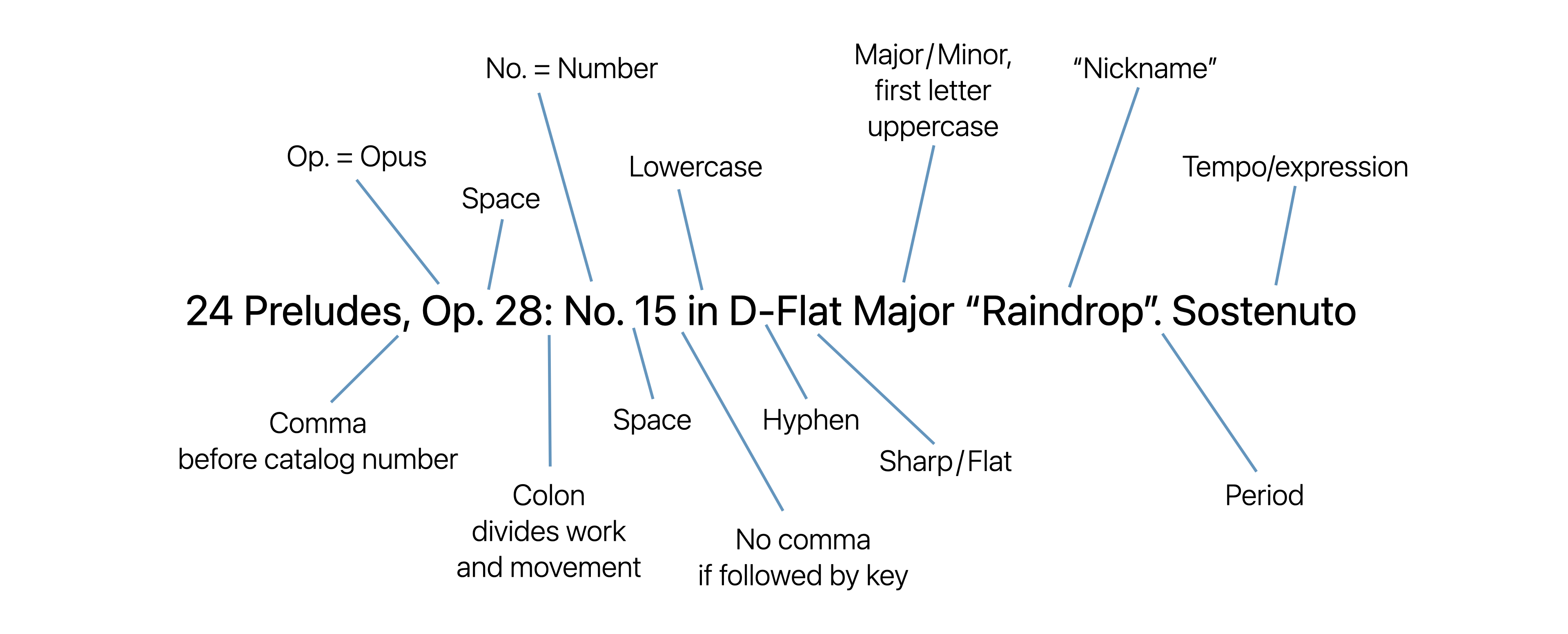
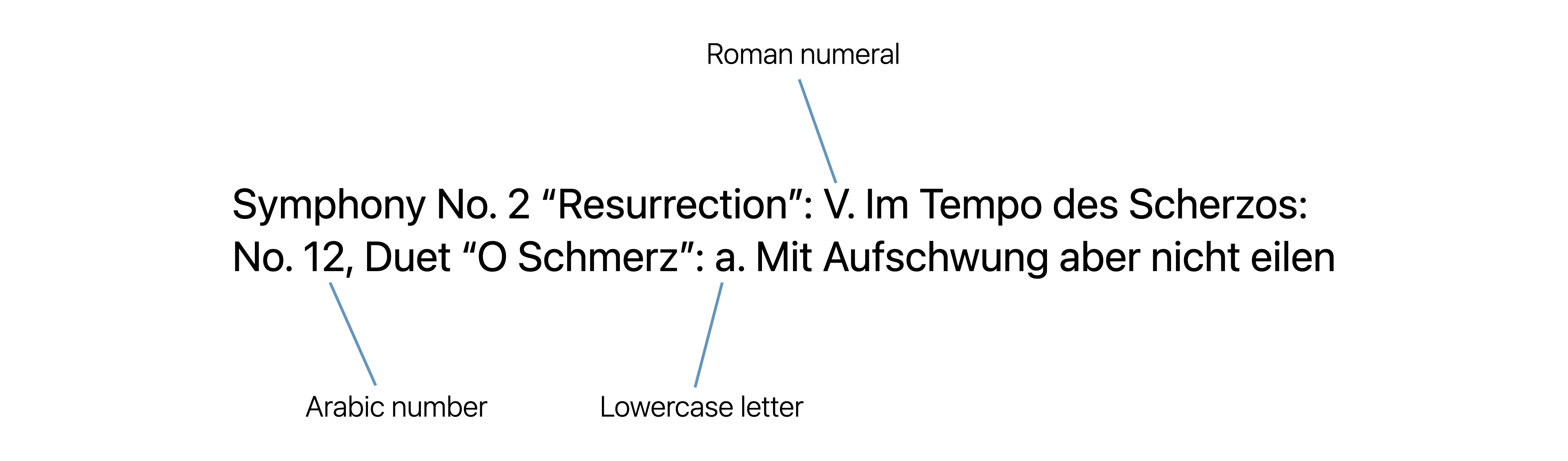
For works comprising movements, such as Symphonies, Concertos, and Sonatas, use Roman numerals. For example, I. Allegro, and II. Adagio. For works comprising numbers, such as Songs and Oratorios, and numbered sets of pieces, such as 6 Lieder or 3 Morceaux, use Arabic numbers. For example, No. 1, Wiegenlied and No. 2, In der Campagna.
Example: Movement Formatting
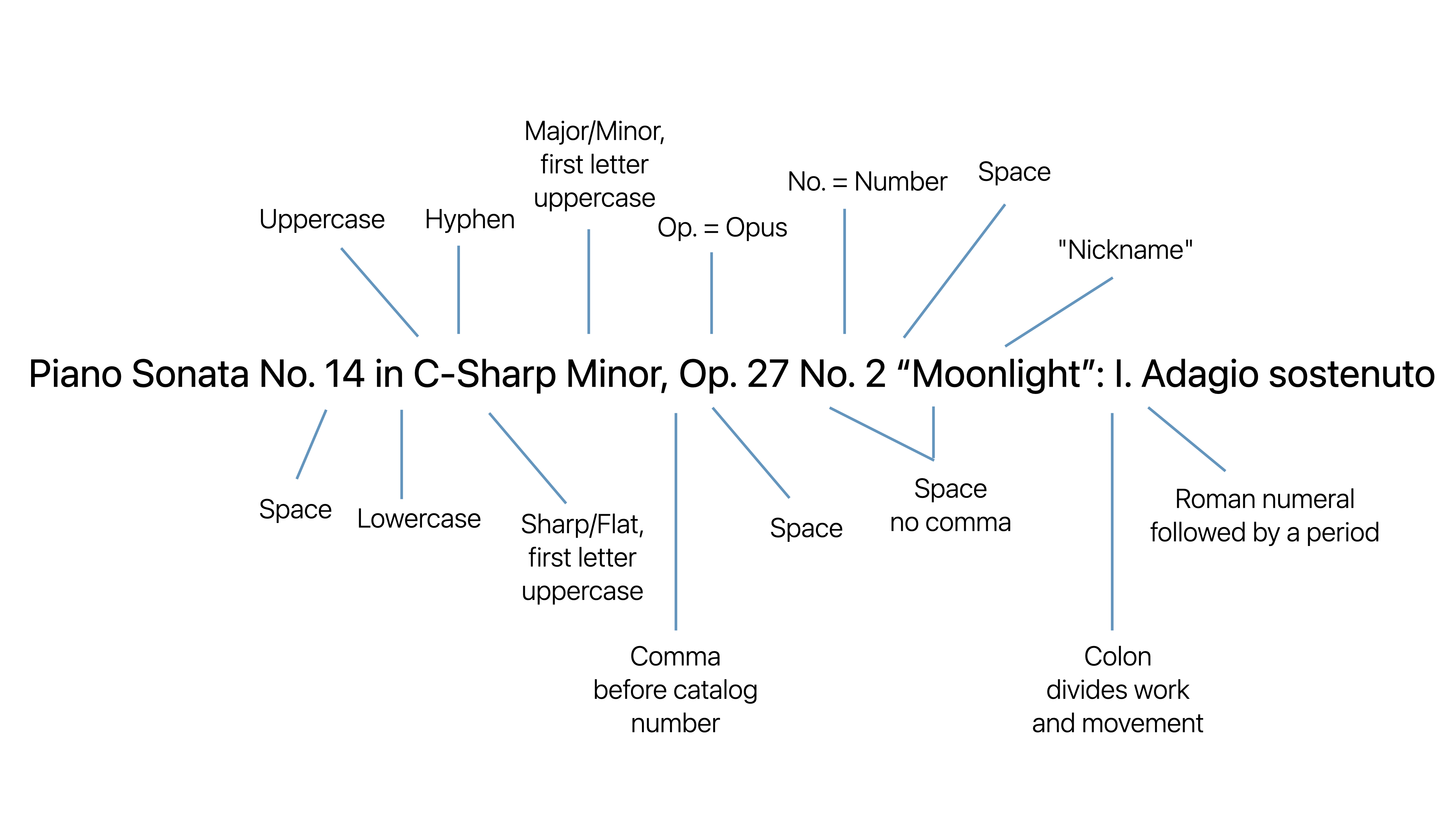
Example: Extended Movement Formatting

Example: Song Cycle Formatting
Example: Set Formatting
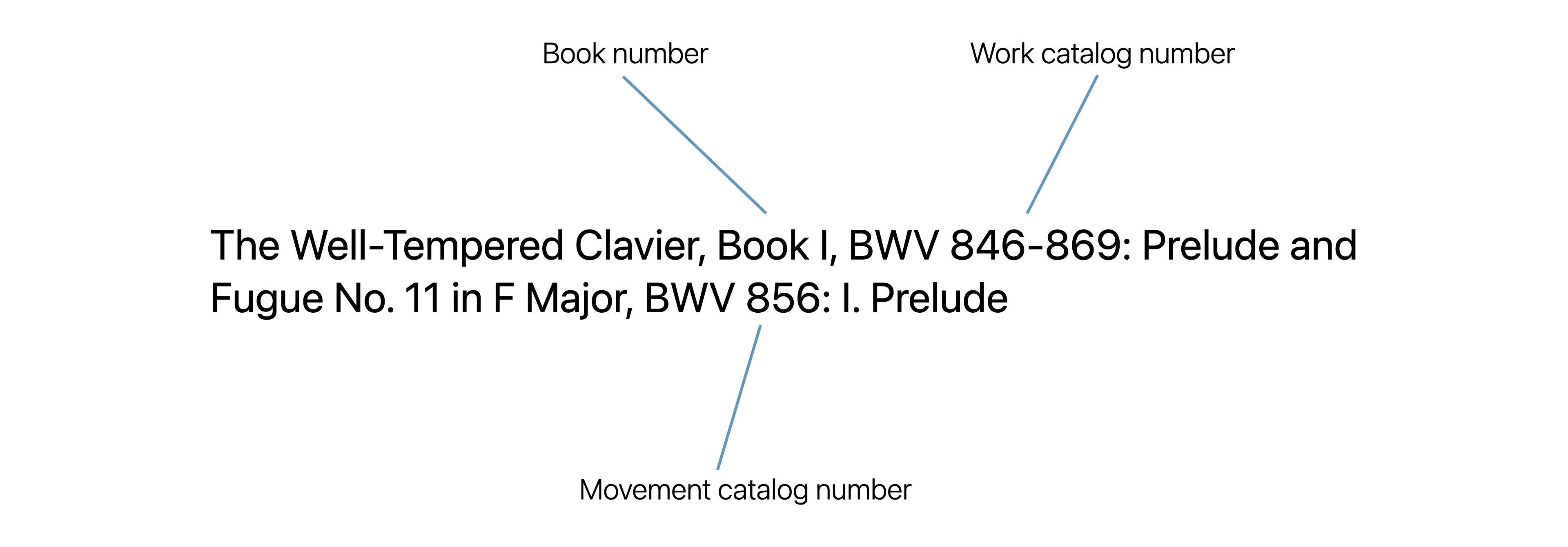
Example: Accommodating Multiple Numbering Systems
Where works are numbered chronologically and by individual Opus groups, they should be formatted as follows:
Nocturne No. 17 in B Major, Op. 62 No. 1. Andante
The example above shows the first of Chopin’s 2 Nocturnes, Op. 62, which is also listed as Chopin’s Nocturne No. 17.
Example: Multi-level works

Examples:
Keyboard Concerto No. 5 in F Minor, BWV 1056: III. Presto
Serenade in G Major, K. 525 “Eine kleine Nachtmusik”: I. Allegro (Excerpt)
Symphony No. 5 in C Minor, Op. 67: I. Allegro con brio
Piano Sonata No. 14 in C-Sharp Minor, Op. 27 No. 2 “Moonlight”: I. Adagio sostenuto
Die Winterreise, D. 911: No. 24, Der Leiermann
1812 Overture, Op. 49 (Excerpt: Finale)
Lyric Pieces, Op. 47: No. 1, Valse-Impromptu
L'isle joyeuse, L. 106
Use dash ( – ) to indicate multiple sections or movements within one track, for example:
String Quartet No. 1 in G Major, K. 80: III. Minuet - Trio
Pictures at an Exhibition: Promenade - The Gnome
Use colon ( : ) to separate the title of a work from the title of a movement or selection, for example:
Cello Suite No. 1 in G Major, BWV 1007: I. Prelude
Requiem, Op. 48: In paradisum
Use period ( . ) to separate the name of a movement from its tempo indication, for example:
Symphony No. 2 in D Major, Op. 36: III. Scherzo. Allegro
Symphony No. 3 in E-Flat Major, Op. 55 "Eroica": II. Marcia funebre. Adagio assai
Use quotation marks ( " " ) to indicate the common nickname of a work, such as:
Variations on an Original Theme, Op. 36 “Enigma”: Var. IX. Nimrod
The following group of tracks are consistently formatted:
Piano Concerto in G Major, M. 83: I. Allegramente
Piano Concerto in G Major, M. 83: II. Adagio assai
Piano Concerto in G Major, M. 83: III. Presto
The following group of tracks are not consistently formatted:
Piano Concerto in G, M. 83: I. Allegramente
Concerto for Piano and Orchestra in G Major, M. 83: 2. Adagio
Concerto in G, M. 83: Presto
The following group of tracks are consistently formatted:
Orchestral Suite No. 1 in C Major, BWV 1066
Orchestral Suite No. 2 in B Minor, BWV 1067
Orchestral Suite No. 3 in D Major, BWV 1068
The following group of tracks are not consistently formatted:
Orchestral Suite No. 1 in C Major, BWV 1066
Suite for Orchestra in B Minor, BWV 1067
Suite pour orchestre n°3 en Ré Majeur, bwv 1068
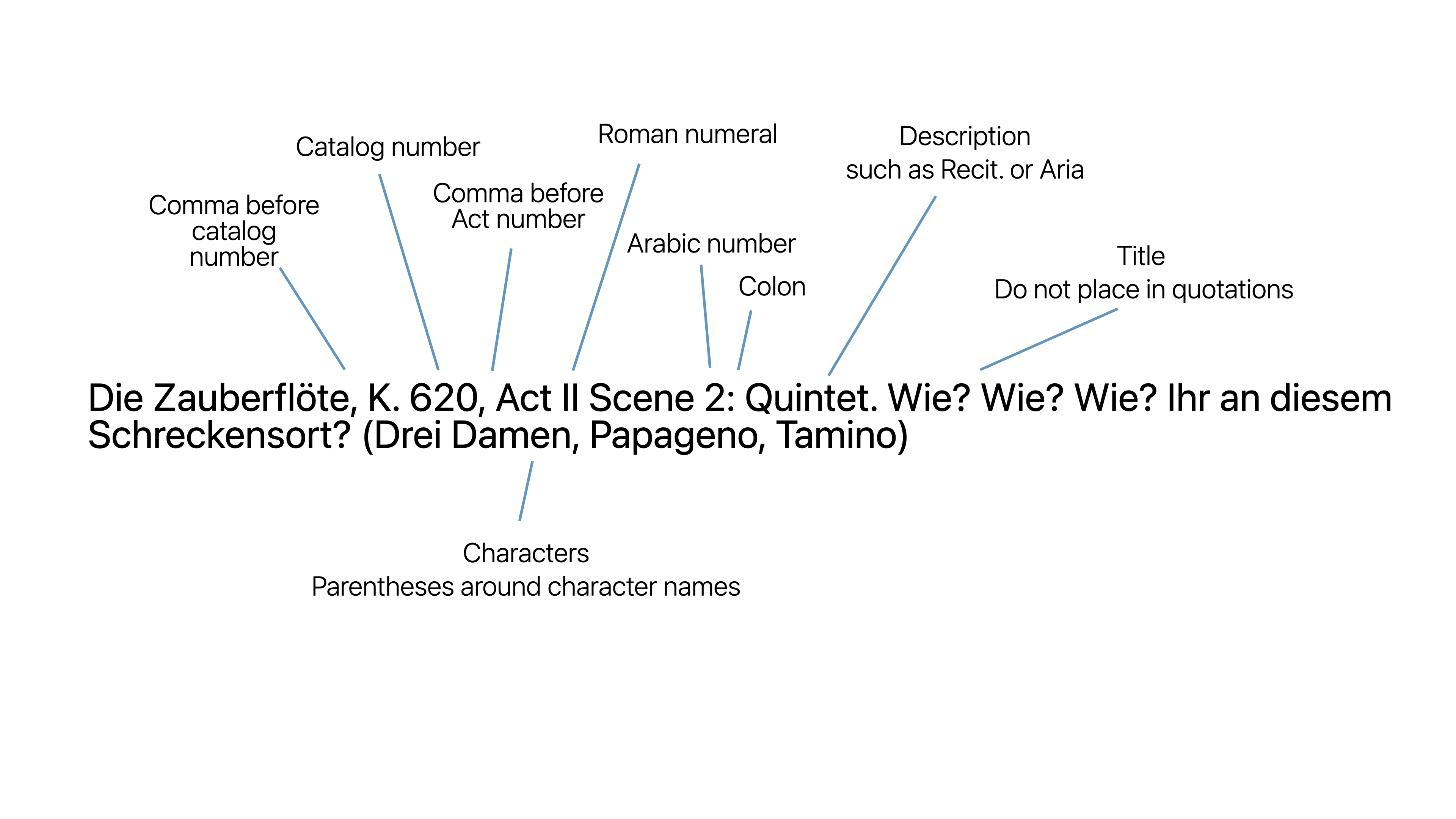
13.11. Opera Formatting. The track title for a selection from an opera must be consistent and start with the name of the opera, followed by a colon, followed by the selection title. For recordings of a complete opera, include act and scene information after the opera title but before the colon and selection title. Exemptions to this rule include operas that have one scene per act, such as Tosca, operas that are divided into scenes but not acts, such as Das Rheingold, or one-act operas that are through-composed, such as Salome. For example:
Opera Selection Titles:
Don Giovanni, K. 527: Il mio tesoro
La traviata: Libiamo, libiamo… (“Brindisi”)
Tosca: Vissi d’arte
Complete Opera Titles:
Falstaff, Act III Scene 2: Un poco di pausa
Falstaff, Act III Scene 2: Ogni sorta di gente dozzinale
Falstaff, Act III Scene 2: Tutto nel mondo è burla
If an album of opera selections includes character information for one title, the information must be included for all other titles. For example:
La bohème, Act II: Quando m'en vo (Musetta)
Turandot, Act III: Nessun dorma (Calaf)
The Magic Flute, K. 620, Act II: O Isis und Osiris (Sarastro und Chor)
A Midsummer Night's Dream, Op. 64: Now until the Break of Day (Oberon, Tytania, Puck, Fairies)
Example: Opera Formatting
13.12. Classical Crossover Formatting. Track titles for Classical Crossover genre content can start with the selection, movement, or popular title of a work. Major work titles and catalog numbers must still be included but may be presented at the end of the title within parentheses. Only use this relaxed formatting on classical-crossover albums.
Examples:
Dance of the Sugar Plum Fairy (From “The Nutcracker”, Op. 71)
Eine kleine Nachtmusik (First movement from Serenade in G Major, K. 525)
Nessun dorma (From the Opera “Turandot”)
Flight of the Bumblebee (From the Opera “The Tale of Tsar Saltan”)
Moonlight Sonata (First Movement from Piano Sonata No. 14, Op. 27 No. 2)
13.13. Works. If grouping songs together as a work, such as a concerto or symphony, at least two songs must be included in the work. Do not group incomplete selections from a larger piece of music together as a work.
13.14. Recording Dates. If the album or track title contains the recording date, use the following format: title, followed by the word “Recorded” and the year recorded in parentheses.
Example:
Mozart: Die Zauberflöte, K. 620 (Recorded 1954)
13.15. Versions, Arrangements, and Transcriptions. If a work has been altered from the original composition, the instrumentation must be noted and the Arranger credited at the end of the title.
Classical Crossover arrangements of Classical works require only the Arranger to be credited at the end of the title.
Examples:
Gianni Schicchi: O mio babbino caro (Arr. for Piano by Arthur Smith)
Toccata and Fugue in D Minor, BWV 565 (Transcr. for Orchestra by Leopold Stokowski)
If all movements of a work have been altered to the same instrumentation by the same arranger(s), place the information in the title after the work name before the colon and movement information.
Examples:
Violin Concerto No. 2 in G Minor, Op. 22 (Arr. for Piano by Georges Bizet): I. Andante sostenuto
Violin Concerto No. 2 in G Minor, Op. 22 (Arr. for Piano by Georges Bizet): II. Allegro scherzando
Violin Concerto No. 2 in G Minor, Op. 22 (Arr. for Piano by Georges Bizet): III. Presto
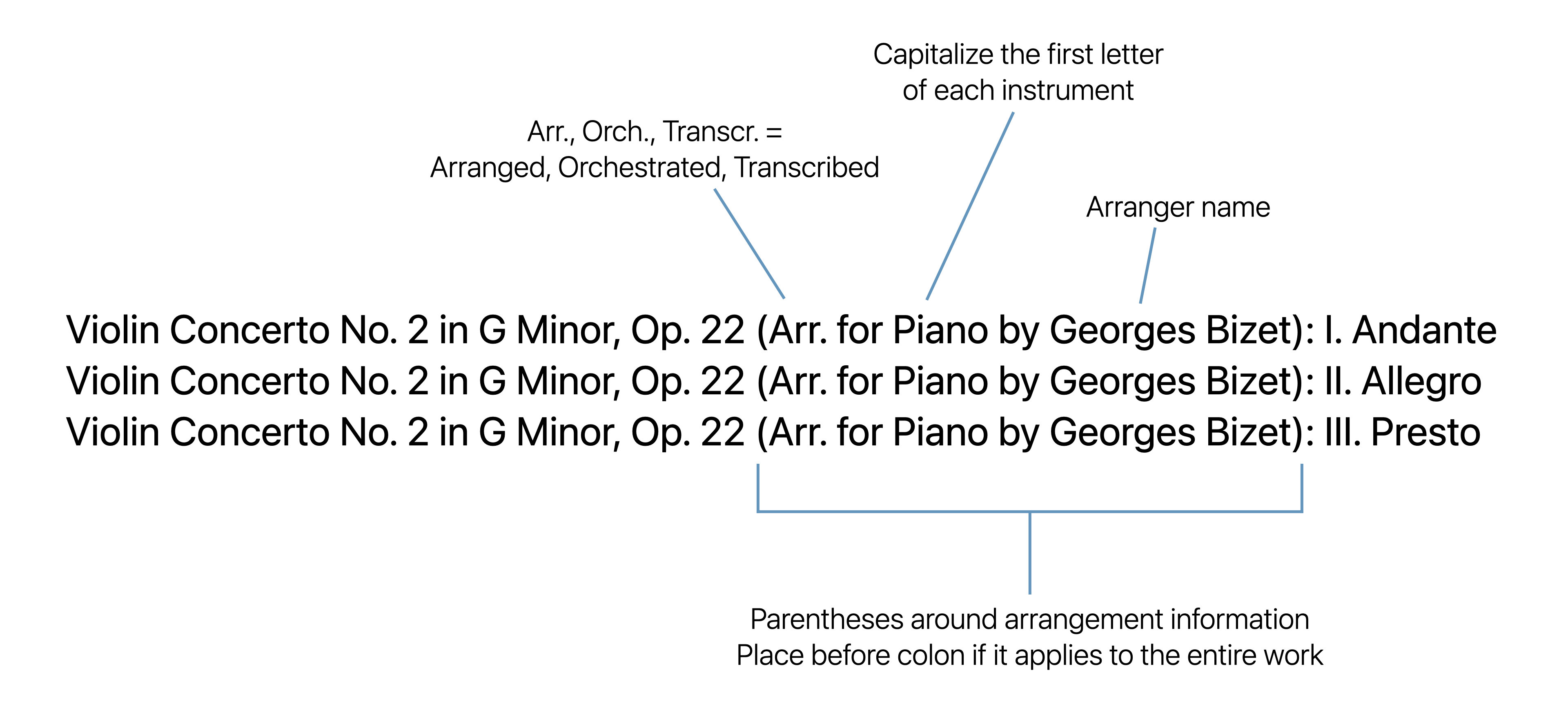
Example: Versions
Example for revisions:
Piano Concerto No. 1 in F-Sharp Minor, Op. 1 (1965 Version): III. Allegro scherzando – Maestoso
Example for alternative instrumentation by the original composer:
Orchestral Suite in D Minor (Version for Piano): IV. Allegro
For transcriptions which are commonly attributed to the transcriber, list the transcriber in the Composer role. This only applies to pieces which are generally attributed to the transcriber in common usage.
For example, most Liszt transcriptions are commonly associated with Liszt rather than the original composer. For these works, Liszt must be credited in the Composer role with original composer listed in the track title.
Examples:
Lohengrin: Elsas Brautzug zum Münster (After Richard Wagner), S. 445 - credit Franz Liszt as Composer
Il Trovatore: Miserere (After Giuseppe Verdi), S. 433 - credit Franz Liszt as Composer